

Rural Northern Ireland falls short of mobile network standards, survey reveals

The results are based on over 20,000 km of road driven and 4.4 million test cycles on EE, O2, Vodafone and Three.
Nearly half of rural measured locations on Northern Ireland’s roads fell short of Basic Performance, the lowest standard in the survey, according to the largest independent survey of Northern Ireland’s mobile networks, published today by Streetwave.
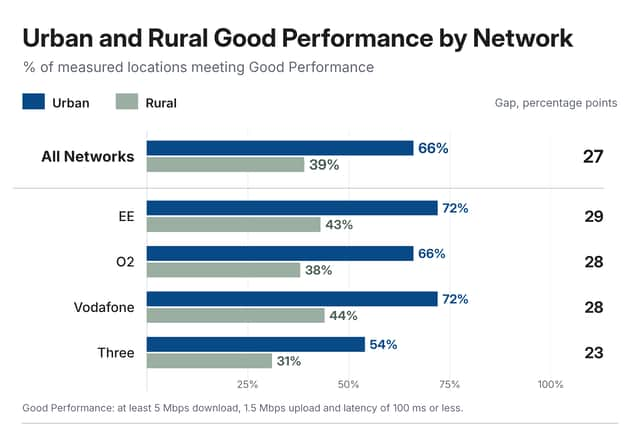
Based on over 2,000km driven and 4.4 million test cycles on EE, O2, Three and Vodafone, no network reached Good Performance at even half of rural measured locations.
Vodafone came closest at 44%, with EE at 43% and O2 at 38%.
Rural areas make up 93% of Northern Ireland’s land. Averaged across the four networks, 45% of rural measured locations missed Basic Performance, the level needed for calls over data and everyday web use such as email.
In urban areas the figure was 19%, and the gap appeared on every network. Good Performance, enough to stream video and make video calls without noticeable delay, was reached at 39% of rural measured locations against 66% of urban ones.
Vodafone also had the best rural Basic Performance result, though it still missed that standard at 39% of rural measured locations.
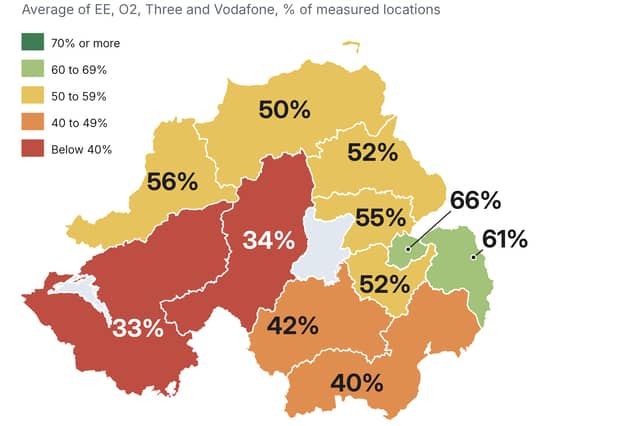
The two most rural council areas, Fermanagh and Omagh and Mid Ulster, had the two lowest results on every network. There, the best network reached Good Performance at 39% and 40% of measured locations respectively.
Belfast led on all four networks, with EE reaching Good Performance at 73% of measured locations.
Ards and North Down ranked second, followed by Derry City and Strabane, with Antrim and Newtownabbey in fourth.
Lisburn and Castlereagh, Mid and East Antrim, and Causeway Coast and Glens followed in suit, with Armagh City, Banbridge and Craigavon, Newry, Mourne and Down, Mid Ulster and Fermanagh and Omagh at the bottom of the list.
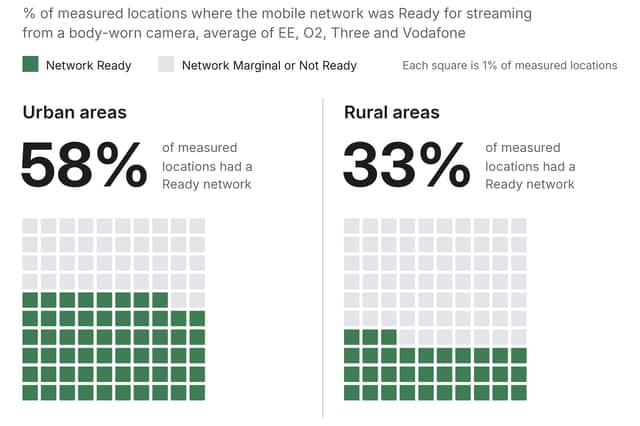
The College of Policing notes that a live stream from a body-worn camera (bodycam) needs a strong, stable signal and may be unreliable where connectivity is poor. Police commanders use that live video to monitor incidents remotely and give officers tactical advice sooner.
On average, the four networks were Ready for it at 58% of urban measured locations and 33% of rural ones. Switching to whichever network worked best at each location would not close the gap.
At a third of rural measured locations, even the best network was Not Ready.
Between September 2025 and June 2026, the test vehicles drove over 20,000km, more than three quarters of Northern Ireland’s public roads, and ran 4.4million test cycles across all four networks.
Angus Hay, Chief Executive Officer and co-founder of Streetwave, said: “Delivering mobile coverage in rural areas is commercially challenging, and this survey is clear evidence that more needs to be done.
“We join Mobile UK in urging government to treat mobile networks as critical national infrastructure and support the reinvestment of annual spectrum licence fees in rural coverage.
“Mobile connectivity is the bedrock of the rural economy, essential to businesses and communities.”
Read the full report, Urban vs Rural Mobile Network Performance, here: https://publications.streetwave.co/urban-vs-rural-mobile-network-performance-northern-ireland-streetwave.pdf