

The sinking of the Arandora Star
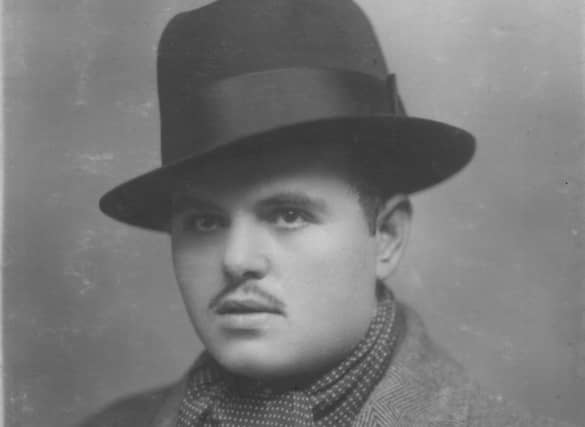

A visit to Rathlin set Michael McRitchie and his wife Brenda on a journey around the north-west coast of Ireland and finally to the mountain town of Bardi in northern Italy. Here he recounts that moving story...
GIUSEPPE Capella rests forever in the little churchyard on Rathlin Island, the victim of a forgotten tragedy.
Eighty years ago, on July 2 1940, the liner Arandora Star was torpedoed off Malin Head with the loss of 800 lives, of which 446 were Italians.
My wife Brenda and I had never heard of the disaster until a friend asked us to photograph the headstone for the Capella family.
When we learned that more Italians were buried in Donegal, we decided to make a video for the families and set off for 10 days in Donegal, Sligo and Mayo, where we pieced together the tragic story from the county newspaper libraries.
Forgotten for decades, we would find 38 Italians in unmarked graves in 29 cemeteries around the Irish coast from Rathlin to Mayo, many beside the British soldiers who had been their guards.
Between 1840 and 1940, some 150,000 Italians emigrated to Britain to escape poverty at home.
They became ice-cream vendors, caterers, sending money home to their families and saving all they could in order to start a business of their own. Northern Ireland acquired names such as Caproni, Forte, Fusco, Morelli, Desano and Rossi.
Then came World War II. In the few weeks up to June 1940, Poland, Norway, Denmark, Belgium, Holland, Luxembourg and France had fallen and Britain stood alone against Nazi Germany, its invasion expected anytime.
LIFELINE At sea, the U-boats were strangling the lifeline to America and more than 60 ships were sunk in June alone. On June 10 Italy declared war on Britain. In this desperate situation there were fears of spying, sabotage and subversion, so all over Britain enemy nationals were arrested and interned.
In Belfast, the RUC arrested Giuseppe Forte, who owned the Continental Cafe in Castle Street and Antonio Fusco, whose family owned a chip shop in York Street. They were taken to Liverpool to board the Arandora Star.
Angelo Morelli, of Portstewart, was stopped at the gangway because the ship was full, taken to the Isle of Man internment camp in Douglas and later released to build the catering business that remains at the heart of Portstewart today.
On July 1 the Arandora Star sailed with 1,200 German and Italian prisoners, guarded by 200 soldiers, and next morning she was torpedoed by a U-boat 75 miles west of Ireland.
Hundreds were rescued by a Canadian destroyer but more than 800 were lost and for weeks their bodies would be washed ashore along 600 miles of coastline from the Western Isles of Scotland to Co Mayo.
The first came ashore in Mayo four weeks after the sinking and a few days later an Atlantic storm brought a terrible harvest. The Western People reported that up to 100 bodies were seen floating off Inishkea Island, the seas so rough that they could not be recovered.
The newspapers reported each grim discovery, stating that the unknown victims had been buried alongside the soldiers, who had been identified by their Army dogtags and paybooks. The soldiers were named in the burial registers, the unknowns were not and we realised that the shallow depressions between the Army headstones were the graves of the unknowns.
Soon, the councils had to reopen old graveyards, some dating from the Famine almost 100 years before. Donegal Board of Health was told that 33 bodies had been washed ashore during the previous week and that funeral expenses had been paid by board officers out of their own pockets.
FUNERALS In Co Mayo, there was one body for every kilometre along the Erris coastline west of Belmullet and the Board of Health became concerned at the cost of so many funerals, with coffins costing £2.10 shillings each. That's around £360 in today's money and these were the poorest areas in Ireland.
On Rathlin, the island's oldest resident, Loughie McQuilkin, showed us a 1940 Coastguard record stating that on August 10 two bodies had been found near the West Light.
One had a document in the name of Capella, the other had nothing and they were buried together. The previous day, two Merchant Navy seamen were buried in Bonamargy cemetery, Ballycastle. A few days later a lifeboat from the Arandora Star was towed into Rathlin Harbour.
Moved by the reaction of the families we contacted, we remade our video in both English and Italian and took the Italian version to Bardi in north west Italy, where one in nine of the victims had come from.
The video has since had thousands of visits on Youtube and still brings emails and cards from all over the world.
In 2017 we heard from Roberto Zazzi in New Zealand: “This video is truly a beautiful thing you have done. The loss of my grandfather, Luigi Zazzi, on the Arandora Star will probably haunt me forever.
“He was last seen in the water with his boyhood friend and fellow waiter in the Savoy Hotel, Giuseppe Capella. Until now, we did not know that any bodies had been recovered from the sea. Thank you for the comfort you have brought to my family.”
It made our day and we were able to tell Roberto that the unknown man buried alongside Signor Capella on Rathlin might, just might, be his boyhood friend. The video can be viewed by Googling ‘Arandora Youtube’ or at: https://www.youtube.com/ watch?v=yAn_We1czsE